
The Harlem Shake: 30 Seconds of Chaos, a #1 Hit, and Who Got Paid
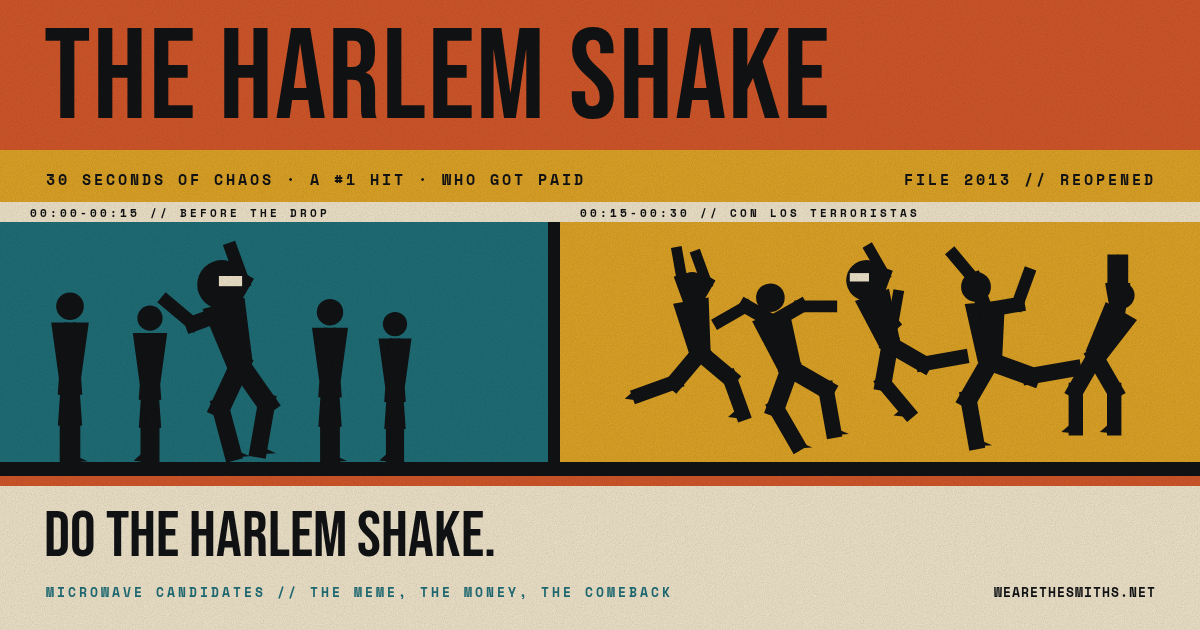
Confession: I started this post in February 2013. It sat in my drafts for almost fourteen years. Here’s what 2013 me wrote, in full:
The latest fad on the net is called the Harlem Shake. It is a net meme that incorporates a song from the mid 90’s by a group/musician Baauer. It starts out with one person dancing. Sometimes in a funny costume, with a group of people surrounding him completely unaware of the dancing. Then as the song progresses there is a bass drop and the whole scene goes nuts and everybody is dancing.
Me, 2013, wrong about the 90s
The format description holds up. The “mid 90’s” part does not. Baauer is one guy, not a group, and the song came out in 2012. So let’s finally do this properly: where it came from, how it blew up, who got paid (and who didn’t), and why it keeps coming back.
The song: a guy, a bedroom, and some samples
Baauer is Harry Bauer Rodrigues, a Philadelphia-born producer who was living in Brooklyn and, in his words, throwing samples together for fun. He put “Harlem Shake” up on SoundCloud in 2012, and about a month later Diplo’s Mad Decent put it out as a free download through its Jeffree’s sub-label.
It’s basically a collage. A reggaeton vocal shouting “con los terroristas,” a lion roar, sirens, synth whistles, a big drop, and one deadpan line: “Then do the Harlem Shake.” Remember those samples. They come back.
The meme: 30 seconds of chaos
The video version started on January 30, 2013, when YouTuber George Miller (yes, the guy who later became the musician Joji) posted a clip of his Filthy Frank characters dancing to the track in costume.
A few days later, five teenagers in Queensland, Australia, calling themselves TheSunnyCoastSkate, made their own version, and that’s the one that locked in the formula: one person in a helmet or mask dancing alone while everyone ignores them, then the drop hits, a hard jump cut, and suddenly the whole room is losing its mind in costumes, underwear and horse heads.
Then it went nuclear. By the numbers (via YouTube Trends and Visible Measures):
- Feb 10, 2013: about 4,000 new Harlem Shake videos a day, roughly one every 21 seconds
- Feb 11: around 12,000 versions and 44 million views
- Feb 15: about 40,000 versions and over 700 million views
- Mar 24: roughly 1 billion views, about 40 days after it started
Everybody did one: offices, college teams, newsrooms, the Miami Heat, even a plane full of people over the Grand Canyon. Matt and Kim set a Guinness record with 3,444 people doing it at once at Rensselaer Polytechnic Institute in Troy, New York.
It literally changed the Billboard charts
This is the part people forget. Billboard had been planning to start counting YouTube plays toward the Hot 100. The Harlem Shake made them move it up. In the very first week YouTube counted, February 2013, “Harlem Shake” debuted at #1, and it stayed there for five weeks. Without the YouTube views it reportedly would have debuted somewhere in the top 15. It ended up the #4 song of the whole year.
A free download made in a bedroom, by a guy most people had never heard of, went to #1 because people filmed themselves in horse masks. That rule change is still how the chart works today.
The controversy: “they came on my land and built a house”
Here’s the problem with a collage of samples made for fun: nobody had cleared them. Once the track was #1 in America, the people whose voices were on it noticed.
- “Con los terroristas” came from Puerto Rican reggaeton artist Héctor Delgado, better known as Héctor El Father, from his 2006 track “Maldades.” By 2013 he’d left reggaeton and become an evangelical preacher (today he pastors a church in Río Grande, Puerto Rico). Nobody had told him his voice was on the biggest song in the country.
- “Then do the Harlem Shake” came from Jayson Musson, a Philadelphia rapper (and later artist, also known as Hennessy Youngman), off “Miller Time” by his old group Plastic Little.
Delgado’s line to The New York Times summed it up: “It’s almost like they came on my land and built a house.” His manager went further and said they could “stop that song,” calling it “a clear breaking of intellectual property rights.” Delgado’s label, Machete Music (part of Universal), started negotiating payment with Mad Decent.
Musson was much more chill about it and said Mad Decent had been “more than cooperative.”
And Baauer? His defense was basically: I’m a kid in a bedroom. He said he’d grabbed the “terroristas” vocal off the internet without knowing where it came from, and later put it more bluntly: “I didn’t clear the samples because I was in my f***ing bedroom on Grand Street.”
By April 2013, Mad Decent settled with both of them for an undisclosed amount. Héctor El Father and two members of Plastic Little got songwriting credits, which means a share of the royalties going forward. So the voices on the record finally got paid.
The kicker: that August, Baauer told Pitchfork (via EDMTunes) he hadn’t seen a dime from the song himself yet, mostly because of the sample legal mess. He also called the whole experience a “mindf***” and said the attention “felt invasive.” He’d sometimes take DJ gigs and then refuse to play it. Meanwhile Mad Decent was collecting ad money from the fan videos through YouTube’s Content ID, and when Azealia Banks posted her own remix, Baauer had it taken down. Fun times all around.
Harlem wasn’t laughing
There was a second, quieter controversy. The Harlem Shake was already a real dance, and the meme had nothing to do with it. The original goes back to the early 1980s at Rucker Park in Harlem, where Albert Boyce, known as Al B., danced at halftime of the basketball games. It became a staple of hip-hop videos in the early 2000s.
When filmmakers went to Harlem and showed people the meme videos, the reaction was not great. Residents called it “an absolute mockery” and said it was “taking our dances and making a joke of it.” A lot of people argued it was a neighborhood’s culture getting borrowed and flattened into a punchline. Fair point, honestly. The meme borrowed the name, and none of the dancing.
When the meme got people fired (and arrested)
- Australia: up to 15 miners were fired after filming a Harlem Shake underground, which broke safety rules
- The Grand Canyon flight: the FAA looked into a Frontier Airlines flight where passengers did it in the aisle mid-flight. The airline said all safety measures were followed
- Egypt: protesters did it outside President Morsi’s headquarters, and four students were arrested for doing it in their underwear
- Tunisia: a school director was suspended over a student version, and it turned into scuffles and a hacked Education Ministry website
- U.S. schools: the National Coalition Against Censorship estimated around 100 students were suspended for doing it at school
And in 2017, it got political in the weirdest way: FCC chairman Ajit Pai did the Harlem Shake in a video defending the repeal of net neutrality, and Baauer and Mad Decent went after the video for copyright. The song had come full circle: now Baauer was the one asking about permission.
The comeback
The Harlem Shake never really died. It just goes dormant and wakes up every couple of years.
- 2022: it had a revival on TikTok, nearly ten years after the original
- February 2024: streamer Kai Cenat opened a Twitch stream with a full Harlem Shake: him walking in, the room frozen, then the drop. The clip blew up and had the internet asking if the Shake was back
- 2026: it’s riding the big nostalgia wave. TikTok is full of “Harlem Shake 2013 – 2026” side-by-sides, “bring it back” posts with over a million likes, teams and brands reposting their old 2013 versions, and somehow Blippi
I don’t think it’ll ever hit 2013 levels again, because nothing will. The internet’s too big now. But the format is basically perfect: 30 seconds, no skill required, one build, one drop, total chaos. That’s why it keeps coming back.
So who actually won?
Héctor El Father and Plastic Little got credits and royalties after the fact. Billboard changed the way music charts work, permanently. George Miller went on to a whole music career as Joji. Baauer kept making music, worked with Rae Sremmurd, Future and M.I.A. (he’s on YouTube and Instagram), put out a debut album, Aa, in 2016, and later got a Grammy nomination, but never had another Hot 100 hit. And Harlem got its name on the biggest meme of the decade without getting to be part of it.
Fourteen years later, I finally finished the draft. Now somebody put on a helmet and stand still.
-Stew
Sources: Wikipedia: Harlem Shake (meme), Stereogum: The Number Ones, Techdirt, HipHopWired, Dancing Astronaut, Rolling Stone, EDMTunes, NPR, NBC News, Dexerto, Digital Music News.